More about the Atlantic Niño
Physical processes, monitoring, and climate change
Quick Facts
| Primary region | Equatorial Atlantic Ocean |
| Monitoring index | ATL3 (3°S–3°N, 20°W–0°) |
| Typical season | June–August |
| Cold counterpart | Atlantic Niña |
| Main impacts | West African rainfall, marine heatwaves, fisheries, tropical climate |
What is the Atlantic Niño?
The Atlantic Niño is characterized by anomalous warming of sea surface temperatures (SSTs) in the eastern and central equatorial Atlantic Ocean. These warm anomalies typically develop during boreal spring, peak between June and August, and dissipate during autumn. Its cold counterpart, the Atlantic Niña, corresponds to anomalously cool SSTs over the same region.
Although it shares several characteristics with the Pacific El Niño–Southern Oscillation (ENSO), the Atlantic Niño differs in important ways. The tropical Atlantic is considerably narrower than the Pacific, the equatorial thermocline is shallower, and ocean–atmosphere interactions operate over shorter spatial and temporal scales. Consequently, Atlantic Niño events are generally weaker, shorter-lived, and more strongly modulated by the seasonal cycle.
The state of the Atlantic Niño is commonly monitored using SST anomalies averaged over the ATL3 region (3°S–3°N, 20°W–0°).
Why does it matter?
Despite its relatively small spatial extent, the Atlantic Niño influences weather and climate across the tropical Atlantic and surrounding continents.
Warm Atlantic Niño events are typically associated with
- enhanced rainfall along the Guinea Coast;
- modifications of the West African monsoon circulation;
- weaker equatorial upwelling;
- warmer upper-ocean temperatures;
- increased likelihood of marine heatwaves;
- impacts on marine ecosystems and fisheries.
Conversely, Atlantic Niña events often produce opposite anomalies.
Physical mechanisms
Mean state
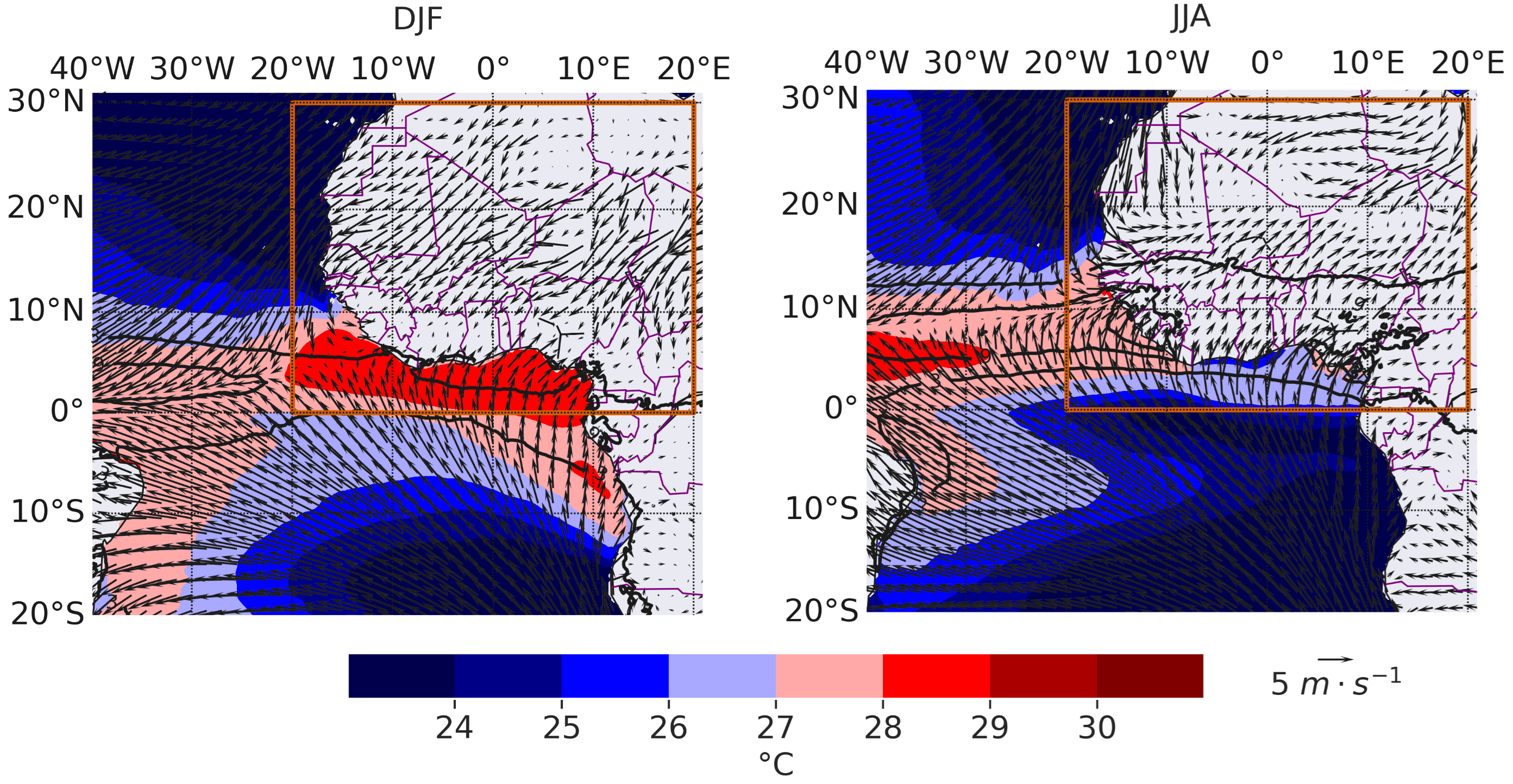
Under climatological conditions, easterly trade winds drive surface waters westward, maintaining a shallow thermocline and vigorous upwelling in the eastern equatorial Atlantic. These processes give rise to the seasonal Atlantic Cold Tongue, which strongly influences regional climate.
Suggested figure
Mean SST, trade winds and thermocline depth.
Initiation
Atlantic Niño events may be initiated by several processes, including
- westerly wind anomalies,
- stochastic atmospheric variability,
- remote forcing from ENSO,
- equatorial Kelvin waves,
- changes in the seasonal Atlantic Cold Tongue development.
Atlantic Bjerknes feedback
Once initiated, ocean–atmosphere coupling amplifies the SST anomalies through the Atlantic Bjerknes feedback.
The sequence can be summarized as follows:
- Westerly wind anomalies weaken the climatological trade winds.
- The eastern equatorial thermocline deepens.
- Upwelling weakens.
- Sea surface temperatures increase.
- Enhanced atmospheric convection develops over the eastern basin.
- Atmospheric circulation further weakens the trade winds, reinforcing the warming.
A schematic showing the Atlantic Bjerknes feedback.
Decay
Atlantic Niño events are usually short-lived. Their decay is promoted by
- seasonal migration of the ITCZ,
- strengthening southeasterly trade winds,
- enhanced upwelling,
- negative ocean–atmosphere feedbacks.
Historical evolution
Atlantic Niño Index
Display a time series from 1950 to present highlighting major warm and cold events.
Major Atlantic Niño events
| Year | Category | Notes |
|---|---|---|
| 1984 | Strong | Warm event |
| 1988 | Strong | Warm event |
| 1998 | Strong | Warm event |
| 2021 | Moderate | Warm event |
Seasonal evolution
Suggested composite figures
- SST anomalies
- Wind anomalies
- Rainfall anomalies
- OLR anomalies
Climate impacts
West African Monsoon
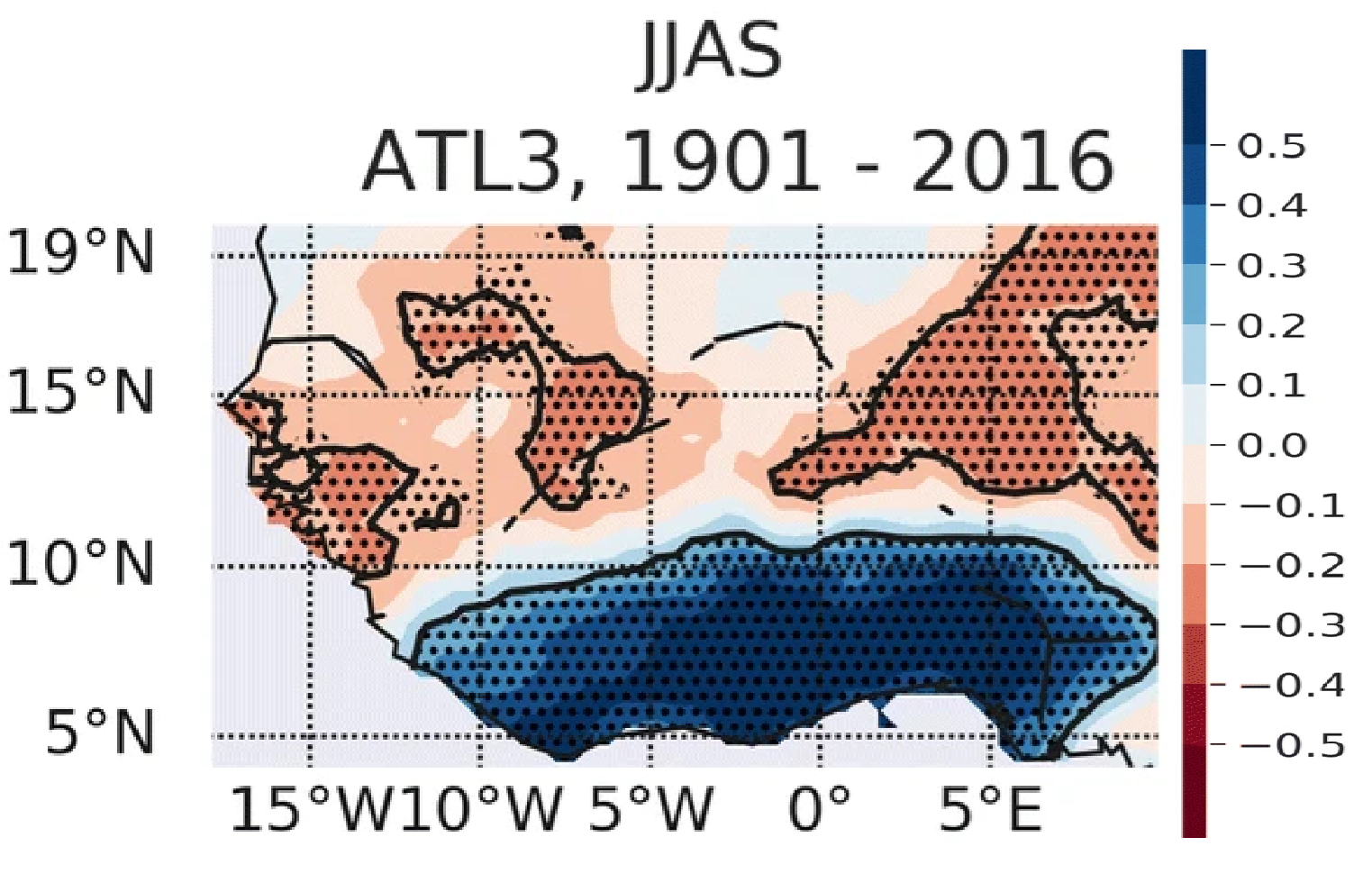
Atlantic Niño events modify convection over the Gulf of Guinea and influence the northward migration of the Intertropical Convergence Zone (ITCZ). Warm events are generally associated with enhanced rainfall along the Guinea Coast, while impacts farther inland depend on season and regional circulation.
Fisheries
Changes in SST and upwelling modify nutrient availability and marine productivity, influencing fisheries in the Gulf of Guinea and adjacent coastal regions.
Tropical Climate
Atlantic Niño events also influence tropical atmospheric circulation, affecting the Atlantic ITCZ, African easterly waves, and potentially tropical cyclone activity.
Predictability
- To be developped*
Atlantic Niño in Climate Models and Future Climate
Climate models are indispensable tools for understanding the dynamics of the Atlantic Niño and assessing how this mode of variability may evolve under anthropogenic climate change. Although simulating the tropical Atlantic remains more challenging than the tropical Pacific because of persistent model biases, recent advances in climate modelling have led to a much clearer picture of the future of the Atlantic Niño.
Simulating the Atlantic Niño
State-of-the-art coupled climate models reproduce the principal characteristics of Atlantic Niño variability, including the seasonal development of the Atlantic Cold Tongue, the Atlantic Bjerknes feedback, and the associated atmospheric circulation anomalies. However, many models continue to exhibit systematic biases, such as
- an overly warm eastern equatorial Atlantic (the “warm bias”);
- a weak or poorly represented Atlantic Cold Tongue;
- errors in the seasonal cycle of SST;
- biases in equatorial trade winds;
- an overly diffuse equatorial thermocline;
- weak ocean–atmosphere coupling.
These deficiencies influence both the simulated amplitude of Atlantic Niño events and their teleconnections to surrounding regions.
A Robust Weakening Under Global Warming
Recent multi-model studies indicate that Atlantic Niño variability is projected to weaken during the twenty-first century under continued greenhouse gas emissions. Independent analyses using CMIP5 and CMIP6 simulations consistently show a reduction in the amplitude of SST variability in the eastern equatorial Atlantic (Worou et al. (2022), Yang et al. (2022), Crespo et al. (2022)). This weakening is particularly pronounced in the boreal summer season, when Atlantic Niño events typically peak.
Unlike ENSO, whose future evolution remains uncertain, the Atlantic Niño exhibits a remarkably robust response across climate models when those models realistically represent the present-day tropical Atlantic climate. :contentReferenceoaicite:2

Why does the Atlantic Niño weaken?
The projected reduction in variability arises primarily from a weakening of the Atlantic Bjerknes feedback.
Several physical mechanisms contribute:
A more stable atmosphere
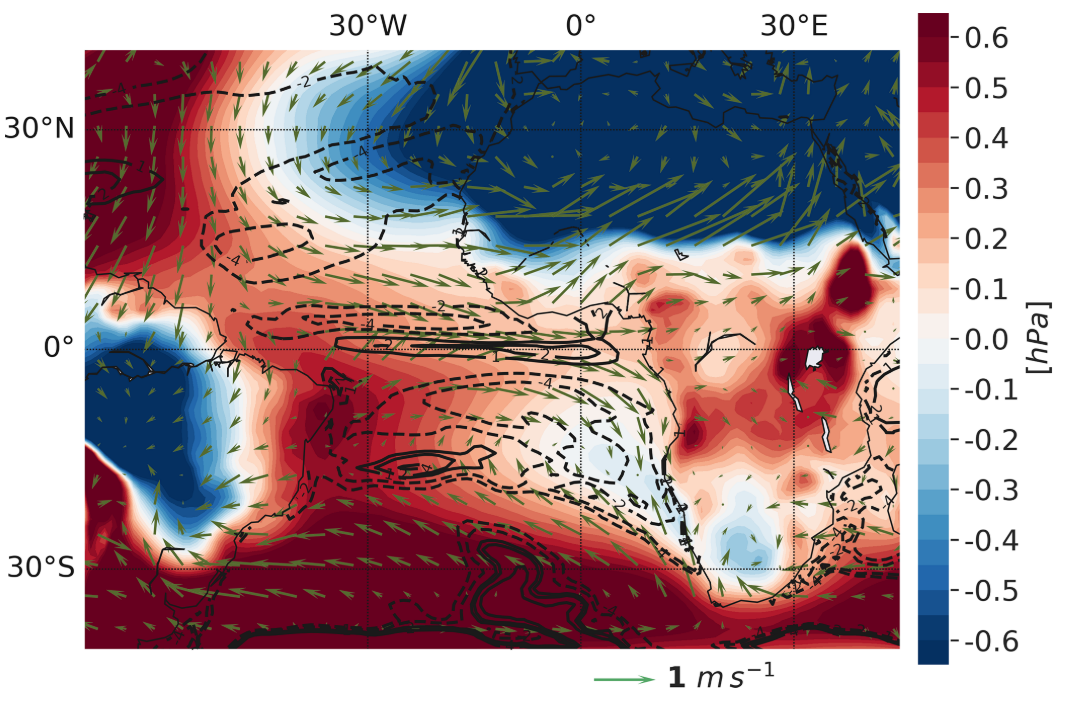
As the tropical Atlantic warms, the lower atmosphere becomes increasingly stable. Consequently, zonal surface winds become less sensitive to SST gradients, weakening the atmospheric component of the Bjerknes feedback. :contentReferenceoaicite:3
A deeper eastern thermocline
Climate models project a deepening of the upper ocean in the eastern equatorial Atlantic. A deeper thermocline reduces the influence of subsurface temperature anomalies on sea surface temperatures, weakening the thermocline feedback. :contentReferenceoaicite:4
Reduced ocean–atmosphere coupling
Because both the atmospheric response and the oceanic thermocline response become weaker, the positive feedback that amplifies Atlantic Niño events becomes less efficient. As a result, SST anomalies are damped more rapidly, producing weaker Atlantic Niño and Atlantic Niña events. :contentReferenceoaicite:5
Implications
A reduction in Atlantic Niño variability has important implications for climate variability around the tropical Atlantic.
Potential consequences include
- weaker interannual SST variability in the eastern equatorial Atlantic;
- changes in seasonal predictability;
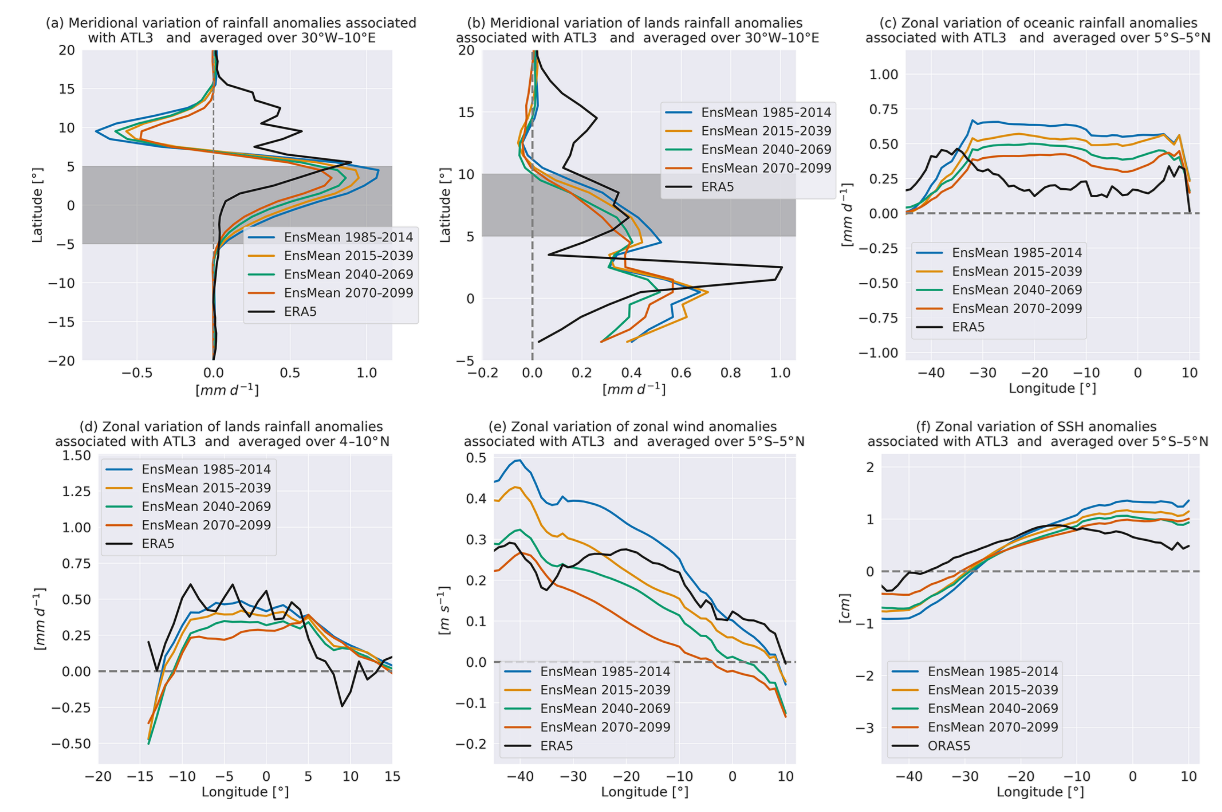
- altered rainfall variability over the Gulf of Guinea and West Africa (Worou et al. (2023));
- modifications to marine ecosystem variability;
Importantly, a weaker Atlantic Niño does not imply fewer marine heatwaves. Greenhouse warming increases the mean ocean temperature, leading to more frequent and intense marine heatwaves, even as the interannual variability associated with Atlantic Niño decreases.
My Contribution
My research has contributed to this emerging understanding by demonstrating a robust decline in Atlantic Niño variability in future climate projections. Using coupled climate model simulations, I showed that the weakening of the Atlantic Niño is closely linked to changes in the mean state of the tropical Atlantic and a reduction in the efficiency of ocean–atmosphere coupling.
These findings were published in Worou et al. (2022)
The projected weakening identified in this work was independently confirmed by two complementary studies published simultaneously in Nature Climate Change, providing strong evidence that reduced Atlantic Niño variability is a robust feature of future climate projections (Yang et al. (2022), Crespo et al. (2022)).